-
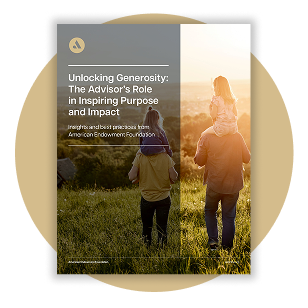
Now Available
Unlocking Generosity: The Advisor’s Role in Inspiring Purpose and ImpactAn industry-wide perspective on integrating philanthropy across advisory lifecycles.
Download Now -
 Introducing a new podcast hosted by
Ron Ransom, CEO, American Endowment FoundationListen, watch, or subscribe now!
LETSTALKDAFS.ORG
What is a donor-advised fund (DAF)?
The fastest growing charitable giving option in the country.
Think of it as an account dedicated to making philanthropy happen. And it’s maintained and operated by a sponsoring organization—like AEF.
Explore the benefits of a DAF
Discover why DAFs are the most popular and fastest growing charitable giving option in the country.
Why do advisors recommend DAFs for charitable giving?
-

No setup charge
-

Funds future giving
-

Simplifies charitable giving & tax reporting
-

Most assets grow tax free
-
Builds legacies & funds future giving





There’s no wrong way to do the right thing.
Between DAFs and private foundations, what’s the best option? It depends on the kind of positive impact donors want to make.
Feature / Consideration
Donor-Advised Fund (DAF)
Private Foundation
Minimum starting contribution
$1,000 to $25,000, depending on the hosting institution
Typically, $1 million – $5 million recommended for efficiency
Setup time
Quick – within days
Lengthy – weeks to months
Setup cost
Minimal to none
Legal fees for drafting, IRS filing costs can be significant
Annual fees
Asset-based fee typically below one percent of the DAF value
Annual fees for filing tax returns, excise tax on net investment income, investment advice, or professional trustee
Control over assets
Donor recommends grants; DAF sponsor has final say
Full control over grants, investments, and operations
Administrative burden
Handled by DAF sponsor (no separate tax filing)
Donors responsible for compliance, IRS filings, governance, and recordkeeping
Income tax considerations
Cash: up to 60% of AGI; Appreciated assets: up to 30% of AGI
Cash: up to 30% of AGI; Appreciated assets: up to 20% of AGI
Decision-making authority for investments
Sometimes, often choose from select managed accounts; greater flexibility for customized investments in larger accounts
Yes, based on bylaws and other governing documents
Annual distribution requirement
Not required by law
Yes, 5% less certain administrative fees
Accepts special assets
In some cases, can accept non-publicly traded stock and other illiquid assets; advanced approval typically required
Yes
Privacy
Yes. Can remain anonymous to grant recipients
No. Must file public Form 990-PF with donor and grant details
Grantmaking flexibility
Restricted to IRS-qualified public charities
Can grant to individuals (for scholarships/ awards) and non-charities with expenditure responsibility
Compensate family members or hire staff
No
Yes, subject to IRS regulations
Successors
Can indicate successor advisors
Can designate successors
Functions of a DAF
A DAF is ideal for someone looking for a flexible giving option that gives the donor the ability to include their family in any giving recommendation, and to easily appoint a successor advisor. A DAF allows charitable dollars to grow tax-free and allows a donor to recommend an anonymous grant to a wide-spectrum of causes or charities.
Functions of a Private Foundation
A private foundation is typically family-funded and requires staff to administer the foundation. Even with a hired staff, this can be a lot of work for a donor to run. There are some IRS minimum distribution requirements, and there is no anonymity when giving to causes and charities.

We understand the significant impact cause-neutral giving can make.
As a cause-neutral sponsor, we offer an unbiased approach to giving—allowing for more freedom to recommend 501(c)3 charities for grants. AEF allows the donor to decide where to recommend grant dollars.
Plus, by working with financial advisors, donors, and firms, we offer a people-driven approach to philanthropy.
American Endowment Foundation (AEF) by the numbers.

$1.79 billion

$7+ million

47,000+
Making an Impact
With so much to consider, it’s important to approach your charitable giving strategically.
Contact Us
Have additional questions? We’re here to help. Reach out with questions.